
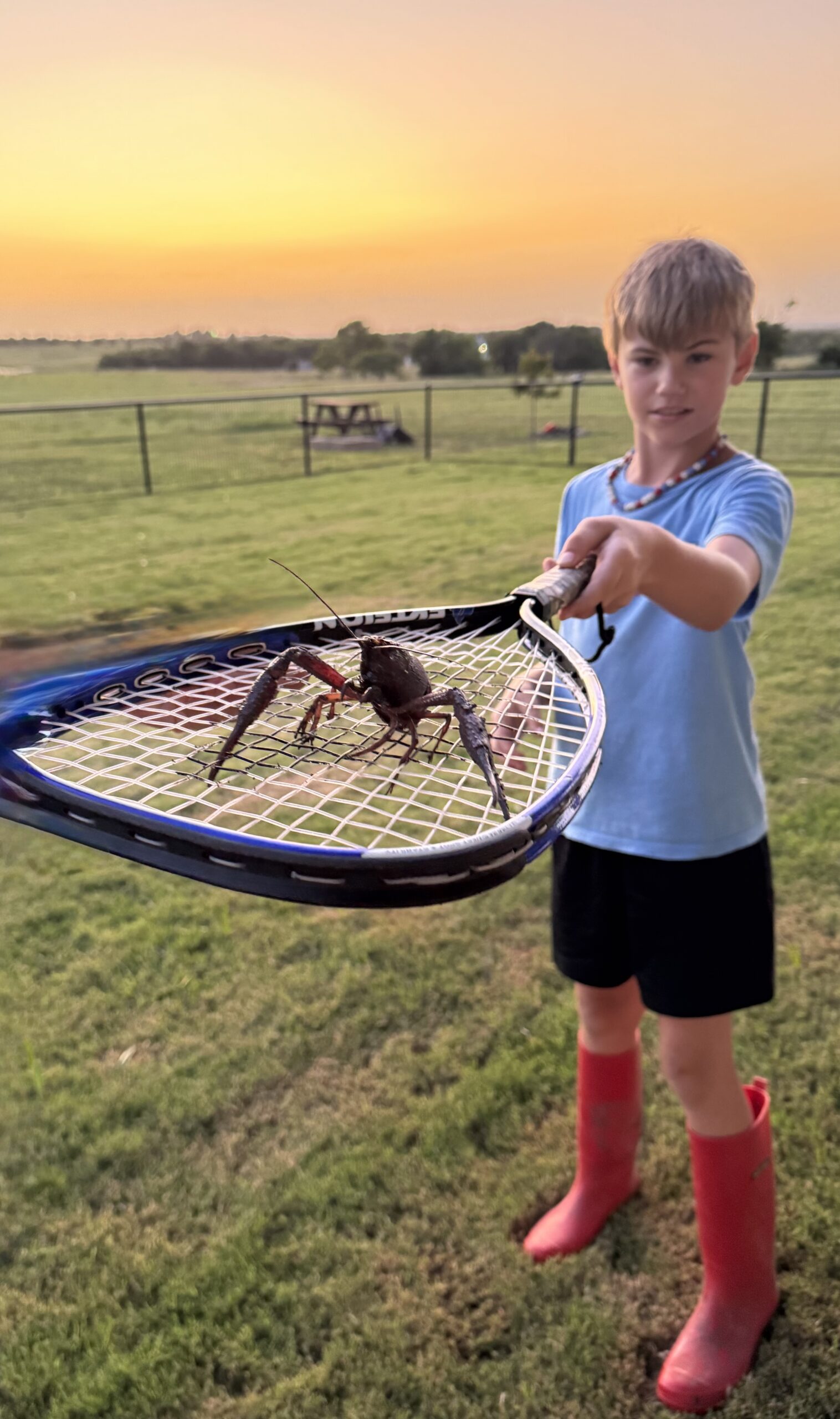
This one comes from the pages of Adventures with Pinkie and Pops and serves as another reminder of why it is called GRAND parenting.

Crawdads? Crawdaddy? Crayfish? Midwestern Lobster?
Whatever you call these little southern crustaceans, when a ten year old boy catches his first one, he can’t think about anything else!
(Just like the Foggy Mountain Boys, we say “Crawdad.”)
Crawdad fishing with kids is a treat, but crawdad fishing with grandkids is lagniappe!
With the help of a cousin, Camdyn caught his first crawdad on Thursday and dedicated Friday to catching his second.

How to Catch a Crawdad:
- Gather Supplies
- String – Thin string like kite string, sewing thread, or fishing line works best.
- Bait – Something that stays firmly together when tied to string or grabbed by pinchers. Bacon works well.
- Pole – Not necessary but helpful when fishing from the banks of a pond
- Shovel – For the most obstinate crawdad-hunting buddies
- Bucket – Any container to hold the catch while you study it
- Eagerness and Excitement!
- The Magic Touch
- Locate the Crawdad Hole
- Look for dirt mounds
- hallow edge of stock pond
- Drop the Bait and Wait
- Statue-like quiescence
- Be Ready
- Light hand on the string to feel the tug
- Eyes peeled for movement of the string
- React
- Spring like a mousetrap.
- Be nimble and quick!
- Land the Catch – Quick, Accurate Aim or Nerves of Steel
- A quick enough aim will land the creature in the bucket, eliminating the need for nerves of steel.
- A buddy comes in handy here – carry a shovel and when you get him near the top, slide the shovel beneath – he won’t get away now!
- If he drops to the ground, the nerves of steel will be required to get him in the bucket. By now, he’s an angry fella choosing fight over flight with pinchers he’s not afraid to use. Only the bravest will grab him barehanded and put him in the bucket!
- Study and Learn
- Respond with wonder and awe
- Notice something unique
- Think about how you can be creative with your new knowledge
- Write or Tell a Story – Fiction or Non-fiction
- Draw a Picture
- Make a Movie
- Release the Crawdad Back in His Habitat
- Unless you’re in Louisiana – then you can have a feast
- We’re in Texas – teach us your ways. Until then – we will practice crawdad catch and release!

Cam gathered the gear and headed to the field.
He had all the right stuff and all the patience a ten year old boy can have.
And no luck…..
He would have to return to the farm another day.
Fortunately for him, we got 4 inches of rain that week.
And when he returned, the field was full of these, signaling optimal crawdad fishing season for kids.

Heavy rains bring the crawdad mounds, and the field was dotted with them, especially near the ponds.
The ones in this picture were about a foot tall.
Under every mound lurks the next catch.
Camdyn retuned with more anticipation and a whole new resolve.
and
SUCCESS!

Not only did he land his first solo crawdad catch, it was a doozie!

With 4 inch pinchers, it was the biggest we’ve ever seen caught around here.
We studied him, measured him, taunted him, talked to him, named him.
(In the heat of the summer, Cam fittingly named him January.)
The family was gathered in our favorite summer evening spot – the back porch – so we all celebrated.
Maybe we even broke out in song…
Led by none other than January, the Conducting Crawdad. (Could he be related to another crustacean we all know and love?)

A great time was had by all, reminding us why crawdad fishing with kids is one of the best ways to spend a lazy, summer afternoon.
Grab a line and take a kid crawdad fishing. You’ll be glad you did.